
Portuguese vs Spanish words can look like twins and still mean completely different things. If you already speak Spanish and you're learning Brazilian Portuguese, these look-alikes are the ones that trip you up first, because your brain assumes that a word that looks the same must mean the same (spoiler: in Portuguese, "rato" is a mouse, not "a little while").
In this list with pictures, I show you 17 Portuguese words that look like Spanish but mean something else in Brazil: taza, vaso, escoba, cartera, escritorio and more. A quick example: if you ask for a "vaso" of water here, we'll give you a funny look, because for us a vaso is a flowerpot or the toilet (vaso sanitário). A glass of water in Brazil is a "copo".
Think of this post as the quick, visual review for Spanish speakers learning Portuguese. If you want each word explained with example sentences, also check out these false cognates in Portuguese that will betray you and these Portuguese false friends that will embarrass you. Some of them will surprise you.
Further down you'll also find the video where I go over several of these words with the right pronunciation. And if you catch yourself mixing both languages without noticing, that has a name: Portuñol. At the end of the post I'll tell you how to leave it behind for good. That's the best part when you learn Portuguese if you speak Spanish: you already know most of the vocabulary, so you only need to watch out for the traps.
What makes Portuguese and Spanish words false friends?
False friends (falsos cognatos in Portuguese, falsos cognados or falsos amigos in Spanish) are words that are spelled or sound almost the same in Portuguese and Spanish but have a different meaning. Linguists also call them heterosemantic words, but in everyday conversation almost everyone just calls them false friends.
The opposite are true cognates: words like "casa", "familia" (família) or "música", which look alike and mean the same in both languages. Since Portuguese and Spanish share most of their vocabulary, your brain assumes every similar word works the same way, and that's exactly where the mistakes happen. If you want the full picture, here are the most important differences between Spanish and Portuguese.
Video: Portuguese Words That Look Like Spanish, Explained
In this video I go over some of these Portuguese words similar to Spanish with the right pronunciation, so you'll recognize them when a Brazilian uses them in a conversation. Watch it before the list: it'll make each word easier to remember.

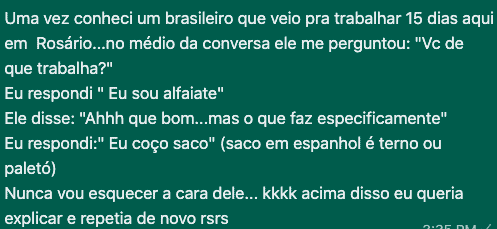
Stories of People Who Fell "Victim" to Portuñol
Here are a few stories from people who got embarrassed in Brazil because they didn't know about these false friends in Portuguese. If something like this has ever happened to you while speaking Portuguese, share it in the comments.
With so many similarities between Portuguese and Spanish, it's really important to watch out for the words that can betray you when you speak Portuguese.

Portuguese vs Spanish Words, One by One
In each picture below you'll see the Spanish word and what a Brazilian understands when they hear it. Then I explain each of these Spanish words in Portuguese, with a practical example and the right way to say it in Brazil.
Heads-up: in the third picture above there's a word that has a pretty racy meaning in Brazil. I don't explain that one here; you'll find it in my post about Portuguese false friends that will embarrass you.
Papa in Portuguese
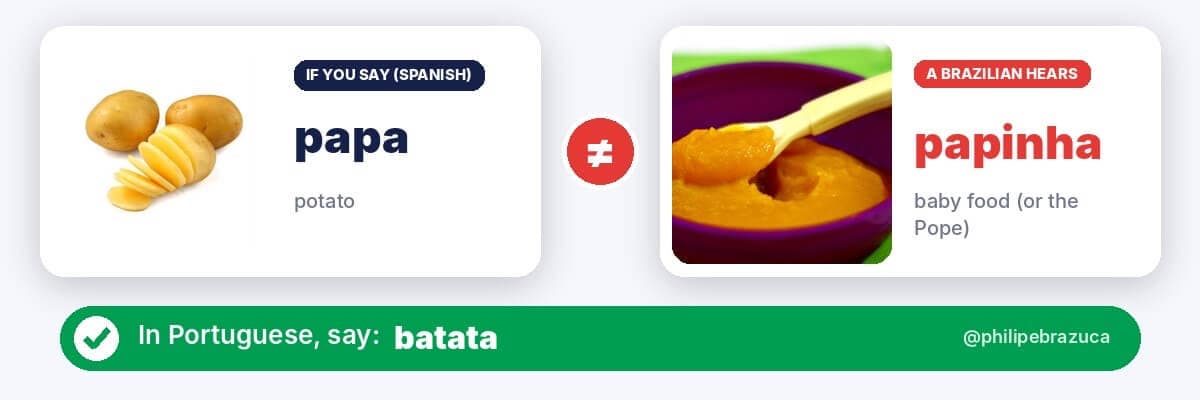
If you say "papa" in Brazil, the first thing we think of is the Pope, the head of the Catholic Church, or papinha, that soft food for babies. The papa (potato) you eat with everything is batata in Portuguese, and papas fritas are batatas fritas.
- "Eu quero um prato de arroz, feijão e batata frita." (I want a plate of rice, beans and fries.)
Taza in Portuguese
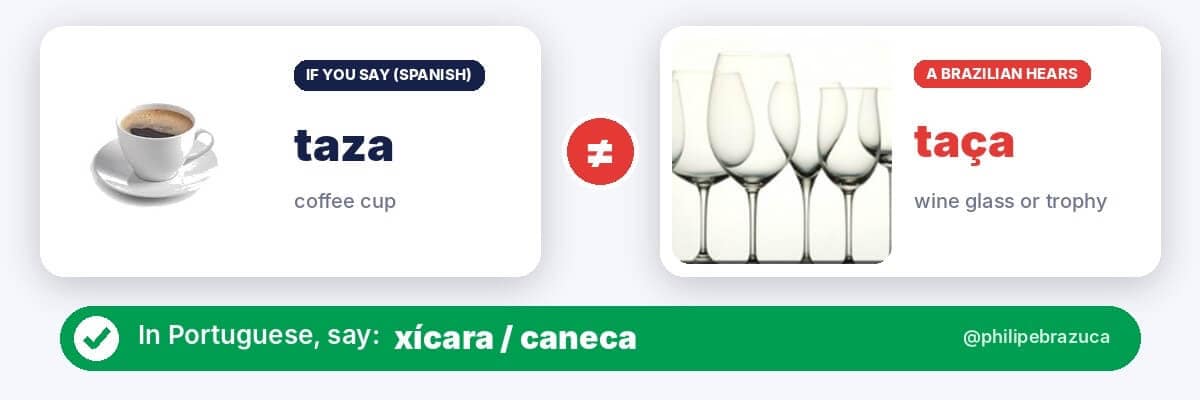
The word taça exists in Portuguese, but it's a wine glass or a championship trophy (that's why we say a team "levantou a taça", lifted the trophy). A coffee cup is a xícara, and a big mug is a caneca.
- "Você quer uma xícara de café?" (Do you want a cup of coffee?)
Escoba in Portuguese
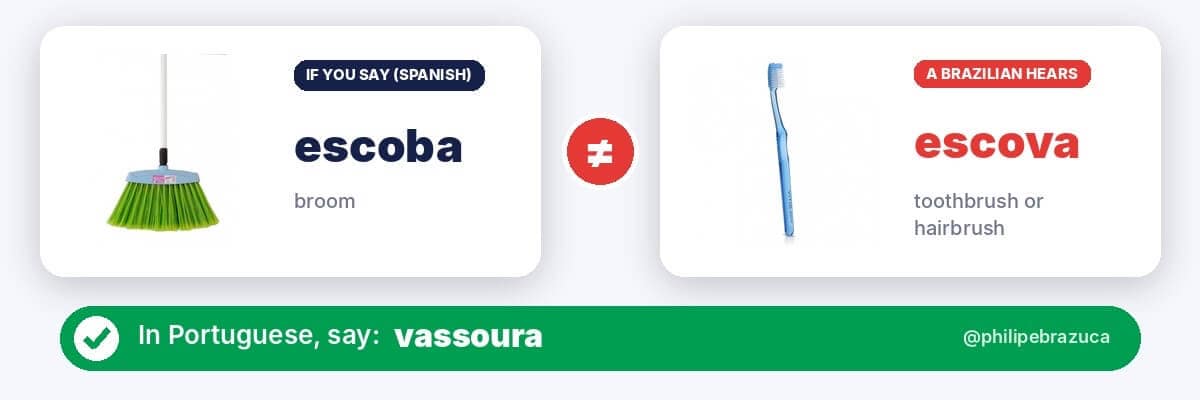
Escova sounds almost the same, but in Portuguese it's a brush: escova de dentes is a toothbrush and escova de cabelo is a hairbrush. The escoba you sweep the floor with is a vassoura.
- "Pega a vassoura e varre a cozinha, por favor." (Grab the broom and sweep the kitchen, please.)
Sorbete in Portuguese
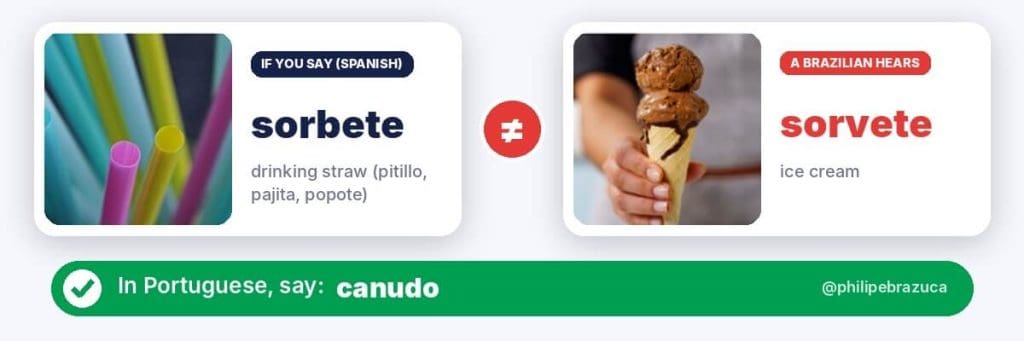
In Argentina and a few other countries, a sorbete is a drinking straw (what others call a pitillo, pajita or popote, all words for a drinking straw), and in Colombia it's a blended fruit drink. In Portuguese, though, sorvete means ice cream. The straw, in Brazil, is a canudo.
- "Me vê um suco de laranja com canudo e um sorvete de chocolate." (Can I get an orange juice with a straw and a chocolate ice cream?)
Vaso in Portuguese
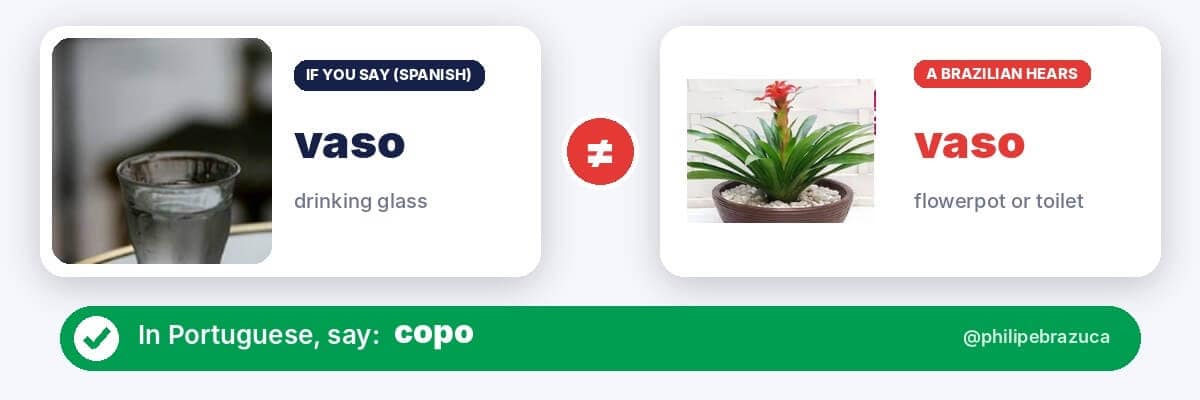
In Brazil, a vaso is the matera (flowerpot) where you grow a plant, or the toilet (vaso sanitário). If you want water, ask for a copo; if it's wine, a taça.
- "Pode me dar um copo de água?" (Can you give me a glass of water?)
Un rato in Portuguese
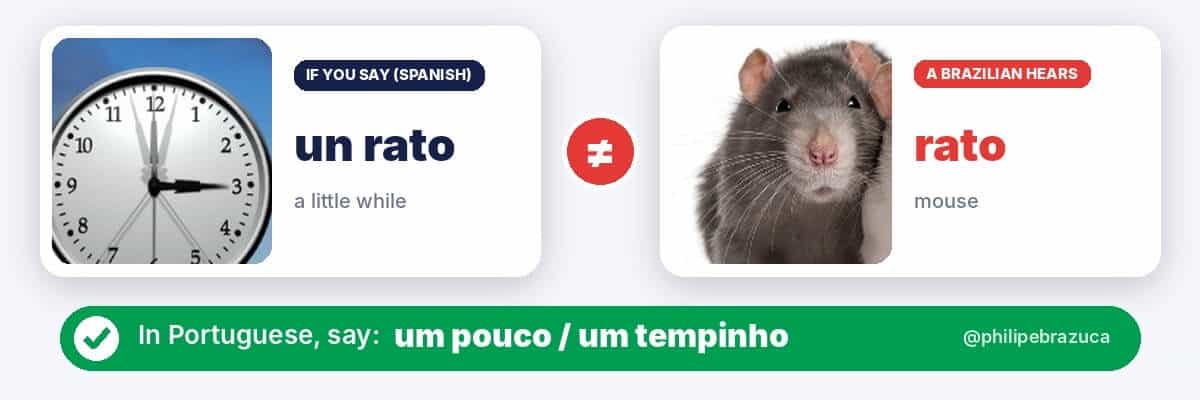
Rato in Portuguese is a mouse, the animal. To say "un rato" in the sense of a little while, we use um pouco, um tempinho or um momento. This is one of the mix-ups that gets the most laughs, and the student story above shows exactly how it plays out.
- "Vou descansar um pouco e depois a gente sai." (I'm going to rest for a little while and then we'll head out.)
How to say AHORITA in Portuguese
Tráfico in Portuguese

Tráfico in Portuguese means illegal trade, like tráfico de drogas or tráfico de animais. Car traffic is trânsito (or tráfego, which is more formal). If you're going to drive in Brazil, this traffic vocabulary in Portuguese will come in handy.
- "O trânsito em São Paulo está horrível hoje." (Traffic in São Paulo is awful today.)
Propina in Portuguese
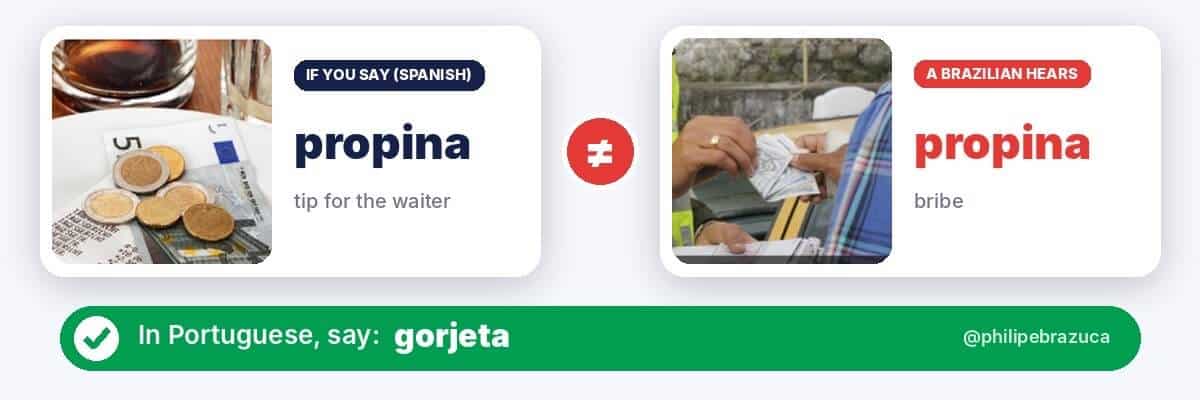
Propina in Portuguese is a bribe, the money you slip someone to do something illegal. The propina you leave the mesero (waiter) is a gorjeta, and in many restaurants in Brazil it already comes on the bill as taxa de serviço. You'll find more words about cash in this guide to money in Portuguese.
- "Deixei uma gorjeta para o garçom." (I left the waiter a tip.)
Cartera in Portuguese
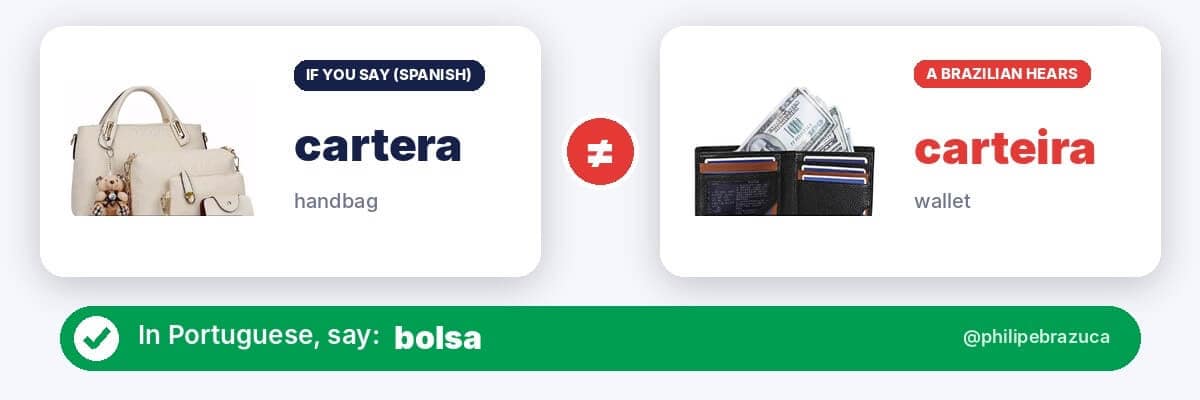
Carteira in Portuguese is the wallet where you keep your cash and ID. It's also a school desk, and it shows up in carteira de motorista (driver's license). The cartera you carry on your shoulder, the handbag people call a cartera in Colombia or Argentina, is a bolsa.
- "Esqueci a carteira em casa e estou sem dinheiro." (I left my wallet at home and I'm out of cash.)
Bolsa in Portuguese
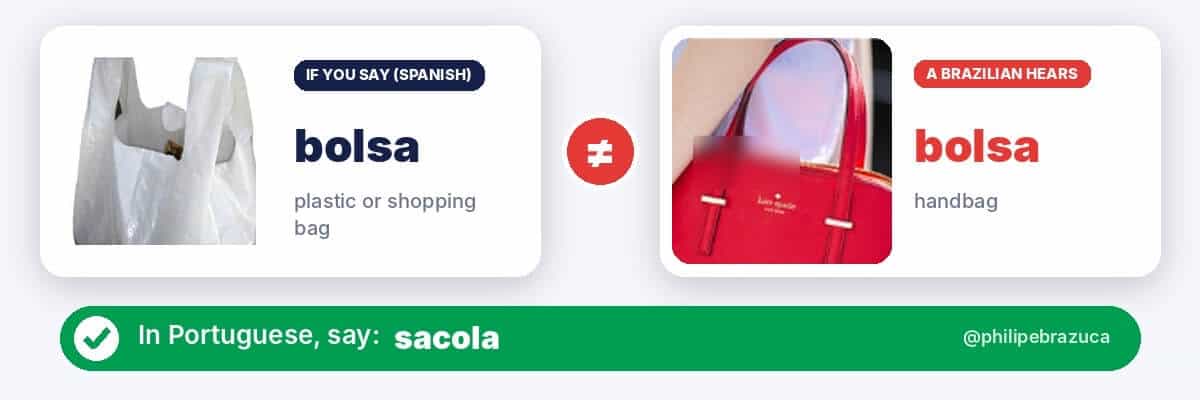
In Portuguese, a bolsa is a handbag or purse. The plastic bag you get at the supermarket is a sacola, and bolsa de estudos is a scholarship.
- "Minha bolsa é pequena, não cabe o guarda-chuva." (My purse is small, the umbrella doesn't fit.)
Bolso in Portuguese
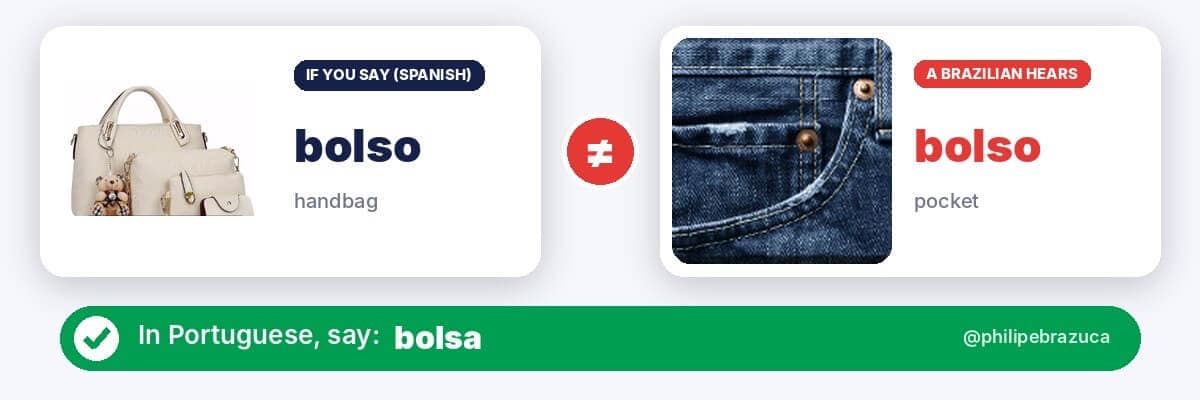
This one confuses almost everyone: bolso in Portuguese is the pocket on your pants or shirt. A handbag is a bolsa, as you saw in the previous word.
- "O celular está no bolso da minha calça." (My phone is in my pants pocket.)
Oficina in Portuguese
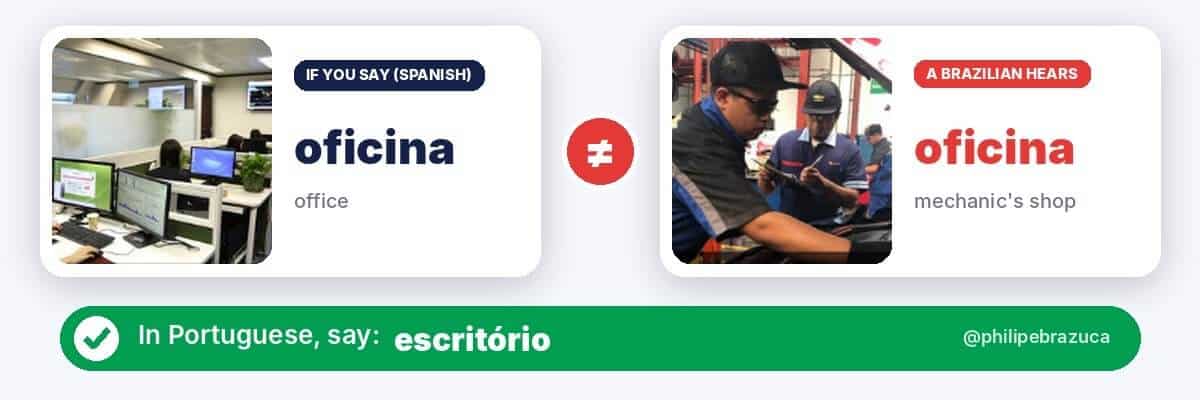
Oficina in Portuguese is a mechanic's shop, where you take your car to get fixed. The office where you work is an escritório.
- "Meu carro está na oficina desde segunda." (My car has been at the shop since Monday.)
Escritorio in Portuguese
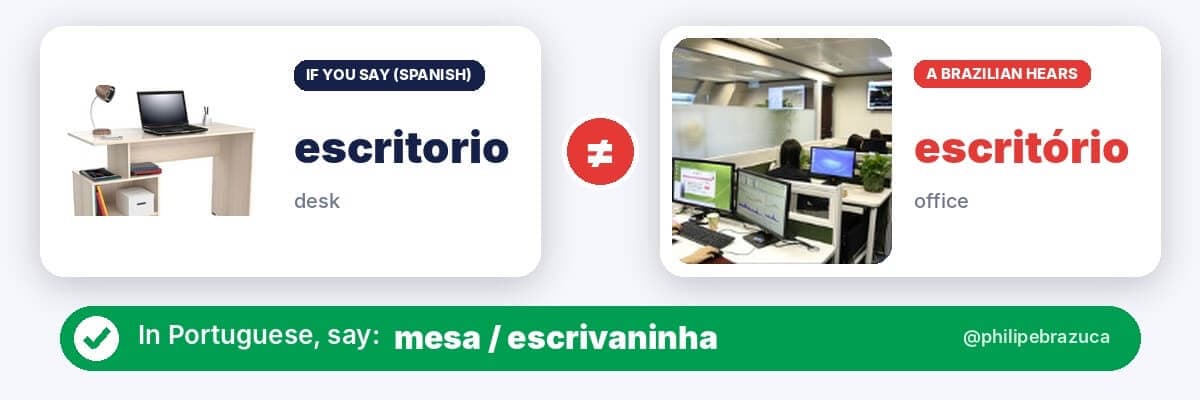
Escritório is the office, the place where you work. The escritorio, the desk where you set up your computer, is a mesa or escrivaninha. If you need more words for your day at the office, check out this guide to work vocabulary in Portuguese.
- "Hoje vou trabalhar no escritório e não em casa." (Today I'm working at the office, not from home.)
Borracha in Portuguese
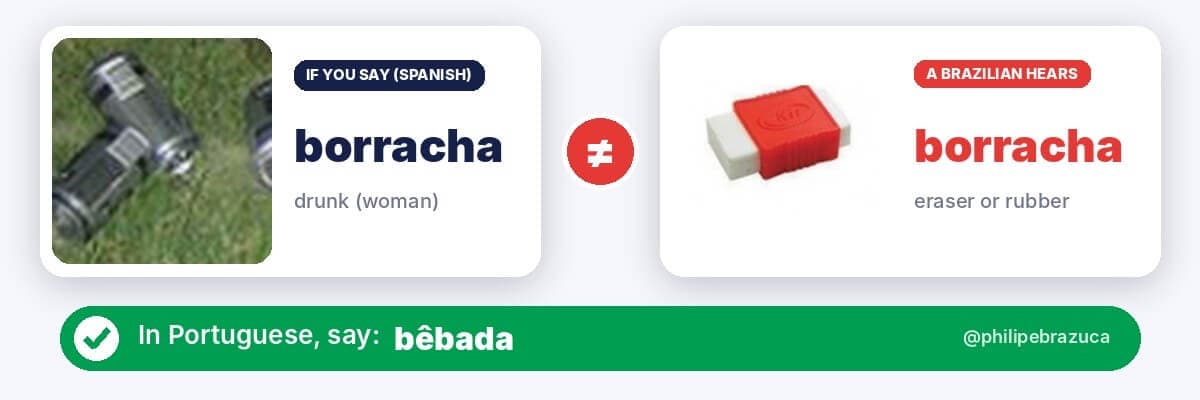
Borracha in Portuguese is an eraser, and also rubber. If you want to talk about a woman who had one too many, the word is bêbada; here I explain how to say drunk in Portuguese with all its variations.
- "Você me empresta a sua borracha?" (Can I borrow your eraser?)
Niño in Portuguese
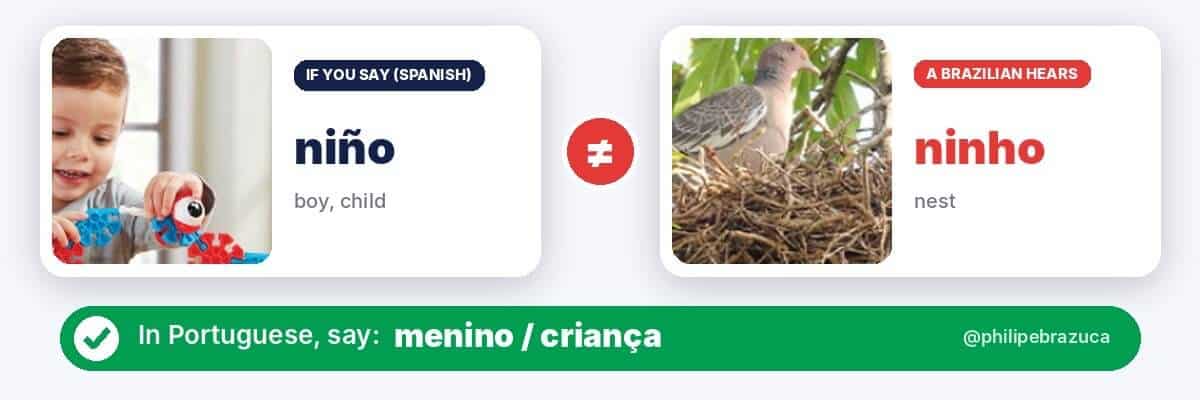
In Portuguese, NH sounds like the Spanish Ñ (or the "ny" in canyon), so if you say "niño", a Brazilian hears ninho, which means nest. A boy is a menino (or criança, for children in general). If NH gives you trouble, go over this guide to Portuguese letter pronunciation.
- "O menino viu um ninho de passarinho na árvore." (The boy saw a bird's nest in the tree.)
Zurdo and surdo
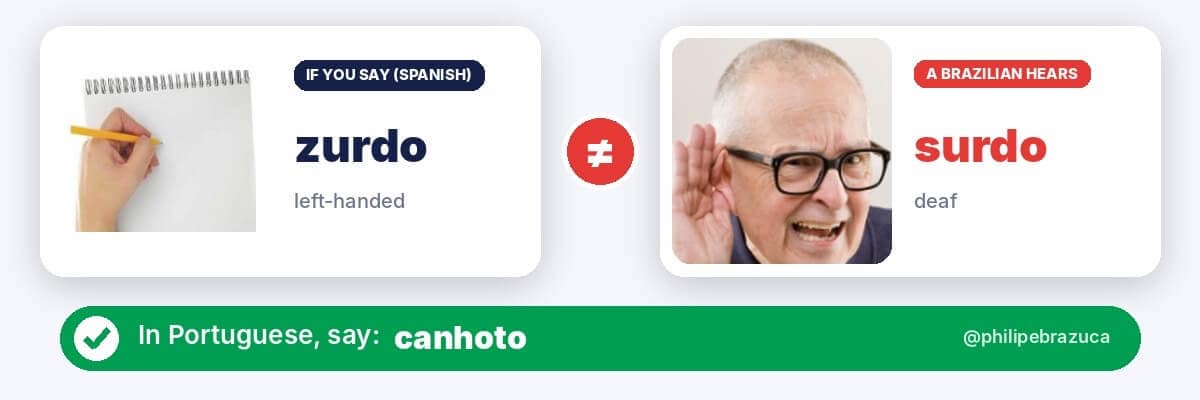
Surdo in Portuguese means deaf, a person who can't hear. To say zurdo (left-handed), we use canhoto. I cover it with more examples in left-handed in Portuguese.
- "Meu irmão é canhoto e escreve com a mão esquerda." (My brother is left-handed and writes with his left hand.)
Apellido in Portuguese
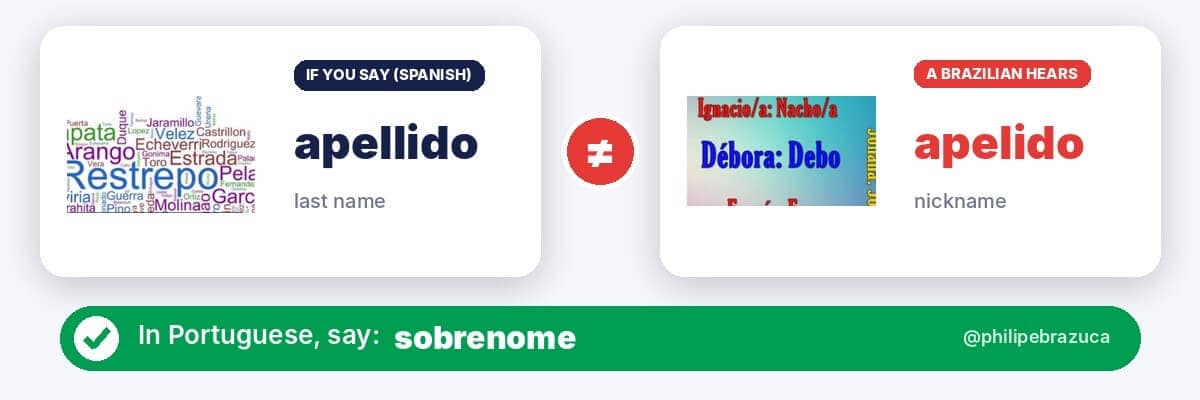
Apelido in Portuguese is a nickname, like Dinho or Bebeto. Your family's apellido (last name) is your sobrenome.
- "Qual é o seu sobrenome? E você tem algum apelido?" (What's your last name? And do you have a nickname?)
Summary Table: Spanish vs Portuguese Words
If you want a quick review, here's the whole list in one table: the Spanish word, what a Brazilian hears and the right way to say it in Portuguese.
| In Spanish | What a Brazilian hears | How to say it in Portuguese |
|---|---|---|
| papa | papa (the Pope or baby food) | batata |
| taza | taça (wine glass or trophy) | xícara / caneca |
| escoba | escova (brush) | vassoura |
| sorbete (drinking straw) | sorvete (ice cream) | canudo |
| vaso | vaso (flowerpot or toilet) | copo |
| un rato | rato (mouse) | um pouco / um tempinho |
| tráfico (car traffic) | tráfico (illegal trade) | trânsito |
| propina | propina (bribe) | gorjeta |
| cartera (handbag) | carteira (wallet) | bolsa |
| bolsa (plastic bag) | bolsa (handbag) | sacola |
| bolso | bolso (pocket) | bolsa |
| oficina | oficina (mechanic's shop) | escritório |
| escritorio | escritório (office) | mesa / escrivaninha |
| borracha | borracha (eraser) | bêbada |
| niño | ninho (nest) | menino / criança |
| zurdo | surdo (deaf) | canhoto |
| apellido | apelido (nickname) | sobrenome |
How to Stop Speaking Portuñol
Mixing up these words is one of the clearest signs of Portuñol, that blend of Spanish and Portuguese that slips out before you even notice. Here I explain what Portuñol is, with examples, and if you want to see the mistakes that come up the most, check out these confusing Portuguese words for Spanish speakers.
And if you want to leave it behind with a step-by-step method, in my course No Más Portuñol I'll walk you through speaking Portuguese without mixing it with Spanish. It's Portuguese for Spanish speakers, taught in Spanish, so it works perfectly if you already speak it.
More Tricky Portuguese Words for Spanish Speakers
Already know them all? These other words also fool Spanish speakers. See if you can guess what they mean before you open each post:
- Molestar
- Sono and sonho
- Words that are spelled the same but pronounced differently
- Portuguese verbs that sound like a serious mistake in Spanish
- 13 mistakes you can avoid when speaking and writing Portuguese


