
Is learning two languages at once a good idea? It can work, but only when one of the two is already part of your daily life. As a Brazilian and a Portuguese teacher, here's my honest answer: if you start two languages from zero at the same time, you'll most likely make half the progress in each one and end up frustrated.
What I do recommend is going in stages: first take one language to an intermediate or advanced level, then split your time 80/20 between the new language and the one you already handle well. It's the plan I give everyone who asks me about learning Spanish and Portuguese at the same time, one of the most common questions I get from English speakers.
Those two languages are the perfect example of why order matters: they share a huge part of their vocabulary and grammar (I show you how much in these differences between Spanish and Portuguese), so learning them together from scratch makes it very easy to mix them up. If you already speak some Spanish, a Portuguese intensive of about three months will take you surprisingly far; to plan it better, see how long it takes to learn Portuguese. Below I explain how to do it, video included.
Video: Learning two languages at once?
Is it possible to learn two languages at once? My short answer: yes, learning two languages at once is possible, but I don't recommend it if you're starting both from zero. In this video I explain why and share the alternative that works best; if what you're after is speed, also check out how to learn Portuguese faster.

Is it a good idea to learn Portuguese and another language at once?
Yes, but only when one of the two languages is already at an intermediate or advanced level. If you start Portuguese and another language from zero at the same time, you split your focus and end up mixing vocabulary and structures; with Spanish and Portuguese that happens even faster, and that's how Portuñol is born.
If your case is Spanish and Portuguese, my advice is to pick the one you need most right now and take it to a comfortable level first: the first language gives you results in a few months, and that motivation carries you into the next one. If you're still not sure about your goal, think first about why you want to learn Portuguese.
I don't recommend learning two languages at the same time, unless…
I don't recommend studying two languages at the same time when both are at a beginner level, unless one of them is already part of your daily life. The reason isn't that it's impossible, it's that moving forward at 50% in each language is almost always slower than taking one to 100% first.
When people ask me whether it's a good idea to learn two languages at the same time, my answer has more to do with method than with what's possible; in other words, even though I know it can be done, I prefer not to do it, and so I don't recommend it.
It's a bit like learning two different techniques at 50% each, for an art I want to master at 100%. In that case, I'd rather focus on becoming really good at my first technique and then move on to becoming just as good at the second one.
Still want to learn 2 languages at the same time? Here's how
To learn 2 languages at the same time without getting tangled up, use the 80/20 rule: 80% of your time goes to the new language and 20% to maintaining the one you already know well. Below is a checklist to see if you're ready to take that step.
Before you jump into learning 2 languages, check whether you already have a solid enough level in the first one.
For example, if you want to learn Spanish and Portuguese at the same time, you need to make sure of a few things. You can learn 2 languages at once if you're already intermediate/advanced in one of them and you're able to:
- Consume native content and understand the language without translating in your head
- Speak the language fluently with a good range of vocabulary
- Read articles and/or books
- Write without spelling mistakes (or as few as possible)
- In short, language #1 already has to be part of your daily life: you don't make an effort to understand or speak it, it feels natural, as if you were speaking your native language.
If that's you, you can start learning another language, with 80% of your time on the one where you're a beginner and 20% on the one where you're already intermediate/advanced; the exact split will depend on how urgently you need each language.
Keep in mind that if you already speak Spanish, learning Portuguese is much faster than starting a language from scratch. One of my recommendations is to do a 3-month Portuguese intensive, reach an intermediate/advanced level and then switch to spending 80% of your time on the next language and 20% staying in touch with Portuguese.
Immersion when learning a language
Immersion means surrounding yourself with the language every day, with music, shows, podcasts and conversations, and it's what speeds up learning the most, whether you study one language or two. If you want to start today with Portuguese, try Brazilian songs with lyrics or Brazilian Portuguese podcasts.
To learn a language, it's really important to absorb as much input as you can: reading, podcasts, music, conversation groups, movies, shows… basically anything within your reach to achieve that "total immersion" that boosts your learning speed through exposure. The formula is simple: Focus + Dedication, or as I always say in my Portuguese videos, Discipline + Motivation + Self-confidence = SUCCESS. That's the key to success.
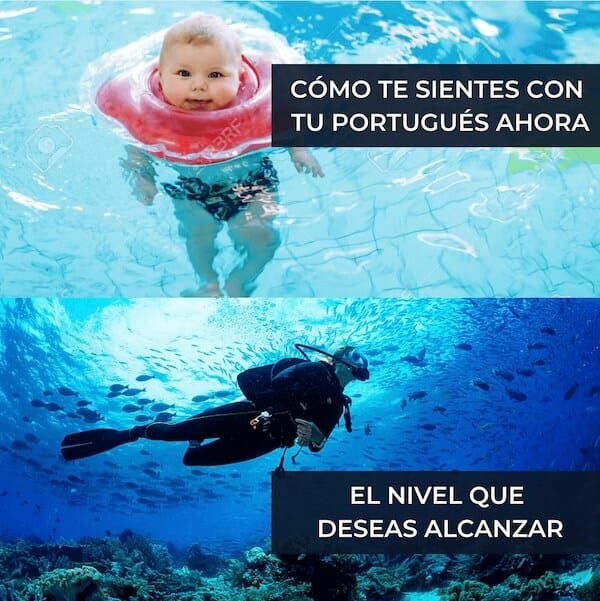
Some languages come from the same language family, and that makes them sound alike (like Portuguese and Spanish, for example). However, once you start getting to know them, you realize they're quite different and that studying them at the same time could slow down and confuse the process. Once you have a solid command of the first one, though, the second will come more naturally, on ground that's already prepared.
Learning a language is exactly that: a challenge, an art
Learning a language is more like training a skill than memorizing a list: you need a method, consistency and a willingness to make mistakes. If the fear of making mistakes is holding you back, here's how to get over the fear of speaking another language. These are the attitudes that will help you the most:
- You have to decode it, understand it and master it
- You need to be willing to step out of your comfort zone
- You have to commit to the time and the method you're going to use
- Explore your creativity and your curiosity
- Take risks all the time
By applying these simple principles, through repetition and immersion, you'll absorb not only the quirks of the language but also connect with the culture behind it. That's the best part!
Once you've had enough exposure, you'll be ready for your next project and, without even noticing, you'll have found a path full of tools that make it easier to learn other languages with the same method and great results.
So, my recommendation? Discover new ways of learning, get creative with your notes and have fun as part of the process; bring each language into your daily activities and never, ever lose focus. Before you know it, you'll find yourself immersed in a new culture and, out of nowhere, speaking a new language.
If you're interested in the differences between Portuguese and Spanish, take a look at this post I made.
[Full post here]