
The most common way to say just in case in Portuguese is "por via das dúvidas", and in casual conversation we Brazilians also say "vai que". Both describe doing something as a precaution, like grabbing an umbrella on a sunny day, because you never know. If you speak some Spanish, this is exactly what "por si las moscas" means: a popular expression in Argentina, Colombia and Uruguay that literally talks about flies, but in Brazil we don't mention flies at all.
In this post I'll show you what por via das dúvidas means, when to use each Brazilian Portuguese equivalent with phrases you can practice, the meaning and origin of por si las moscas, and a super common mistake among Portuguese learners: mixing up "dúvida" and "dívida". And a fun fact: fly in Portuguese is also "mosca", and we use it in other expressions, just not this one.
If you like this kind of phrase, I also recommend my list of the most common Brazilian expressions to sound more natural in any conversation.
Video: Different ways to say "just in case" in Portuguese
In this short video I show you different ways to say just in case in Portuguese, like "por via das dúvidas" and "vai que", the way we say it in Brazil. Watch it and repeat the phrases out loud; if you enjoy this style, you'll also like my guide to Brazilian slang.

Por si las moscas meaning and origin
"Por si las moscas" is a popular Spanish expression that literally means "in case of the flies" and is used to justify a precaution, just like "just in case" in English. Its origin isn't documented with certainty, but the most accepted explanation comes from something very ordinary: flies. And if you're curious about how these phrases change from one country to another, check out the Brazilian version of 27 Colombian expressions.
The idea is that flies are annoying, untimely and unpredictable: you never know when they'll show up, so it's better to be prepared. In the past, in rural areas and also in cities with poor hygiene, flies could spread disease, contaminate food or simply be a nuisance.
Article (in Spanish): "Por si las moscas": The origin of the most famous Spanish expressions
"Por via das dúvidas" in English: what does it mean?
The Portuguese expression "por via das dúvidas" is used when someone does something as a precaution, to be ready for something that may or may not happen.
It's like saying:
- "I'm going to do this just to be safe, in case something unexpected happens."
Examples:
- "Levei um guarda-chuva por via das dúvidas."
- "Acho melhor você levar o carregador do celular por via das dúvidas."
In English, it's the same as saying "just in case" or "to be on the safe side".

Even without knowing whether it will rain, the person takes an umbrella just to be sure.
How to use ACHAR in Portuguese
How to react to good and bad news in Portuguese
Don't confuse "dívida" with "dúvida"
"Dívida" and "dúvida" are very similar words in Portuguese, but their meanings are completely different. A quick trick: "dúvida" looks like "doubt", and "dívida" is your "debt".
Don't confuse "ter uma dívida" (to have a debt) with "ter uma dúvida" (to have a question).
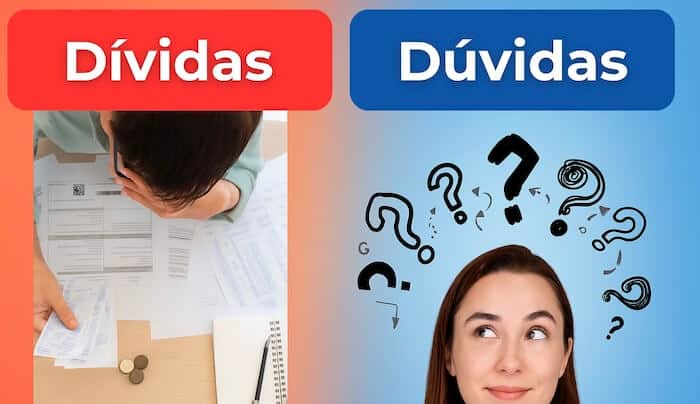
For example:
- "Tenho uma dúvida sobre a aula de português." (question)
- "Ele tem uma dívida no banco." (debt)
Words and expressions related to money in Portuguese
"Vai que": what does it mean?
"Vai que" is a more informal, colloquial expression that means:
- "What if this or that happens?"
It's a way of picturing an unexpected possibility and, because of that, playing it safe.
Examples with "vai que":
- "Leve um guarda-chuva. Vai que chove."
- "Se eu fosse você levaria o documento físico, vai que o seu celular descarrega."
Sounding more Brazilian: people will think you're from Brazil
Other ways to say "just in case" in Portuguese
Besides "por via das dúvidas" and "vai que", in Brazil we have other common phrases to talk about being careful, some more informal and others more formal. And if you came here looking for por si las moscas in Portuguese, these all work as equivalents too.
"Só por garantia" and "pra garantir"
They mean "just to be sure" and are among the phrases we use most in everyday life in Brazil. "Pra" is the spoken form of "para".
- "Vou salvar o arquivo de novo, só por garantia." (I'm going to save the file again, just in case.)
"Nunca se sabe"
Just like "you never know" in English, it goes at the end of the sentence to justify a precaution against something that could happen.
- "Leva um casaco, nunca se sabe." (Take a jacket, you never know.)
"Se por acaso"
It's the equivalent of "if by any chance" or "in case". Watch out: "por acaso" on its own means "by chance", not "just in case"; it's a detail that trips up a lot of learners, much like the Portuguese false friends.
- "Se por acaso você precisar de ajuda, me liga." (If by any chance you need help, call me.)
"Por precaução"
This is the most formal option, the one you'll see in the news, in notices or at work. It means exactly "as a precaution".
- "Por precaução, a escola cancelou as aulas." (As a precaution, the school canceled classes.)
"Seguro morreu de velho"
It's a Brazilian saying that means you can never be too careful, much like "better safe than sorry". Literally, "the careful one died of old age". If you like these, check out more Brazilian sayings.
- "Fiz backup das fotos. Seguro morreu de velho!" (I backed up the photos. Better safe than sorry!)
Fly in Portuguese: expressions with "mosca"
Fly in Portuguese is "mosca", and in Brazil it sounds like "MOHS-kah" (in Rio de Janeiro, "MOHSH-kah"). Even though we don't use it to say just in case, it shows up in several very common Brazilian expressions, just like the fruit idioms in Portuguese.
"Acertar na mosca"
It means to get something exactly right, to hit the bullseye or, as we say in English, to "hit the nail on the head".
- "Você acertou na mosca: era isso mesmo que eu queria." (You hit the nail on the head: that's exactly what I wanted.)
"Estar às moscas"
It's used for an empty place, with no customers and nothing going on, as if only flies were there. In English we'd say a place is "dead".
- "O restaurante estava às moscas na segunda-feira." (The restaurant was dead on Monday.)
"Mosca-morta"
Literally "dead fly", it describes someone who seems shy or harmless but isn't. It's close to the English "looks like butter wouldn't melt in her mouth".
- "Ela parece mosca-morta, mas é muito esperta." (She looks like butter wouldn't melt in her mouth, but she's very sharp.)
"Comer mosca"
Literally "to eat a fly", it means getting distracted or careless and missing something important because you weren't paying attention. Think "you snooze, you lose".
- "Não come mosca, a promoção acaba hoje!" (Don't snooze on it, the sale ends today!)


