
What does desmanchar mean? Here's the desmanchar meaning in a nutshell: in Portuguese, desmanchar means to undo, take apart or dismantle something that was already made, and "desmanche" is the result of that. Here in Brazil, "um desmanche" is also the place where cars get taken apart so the parts can be sold, what you'd call a salvage yard or an auto wrecker in the US.
Don't let the spelling fool you: mancha means "stain" in Portuguese, so it's easy to assume that desmanchar in English would be "to remove a stain". It isn't. When a Brazilian says "desmanchei o nó", it means they undid the knot. It's one of those Portuguese words that can trick you.
Desmanchar is a regular -ar verb, always spelled with CH (never "desmanxar"), and that CH sounds like the "sh" in "shoe". So if you need a way to say undo in Portuguese, this is a great one. You'll hear it a lot as "desmanchou" (undid), "desmanchando" (undoing) or "desmanchado" (undone), and in everyday phrases like desmanchar o penteado (to mess up your hairdo), desmanchar um namoro (to break up) or "o sorvete se desmanchou" (the ice cream melted).
Below I'll show you when to use desmanchar vs desfazer, practice sentences with English translations, and what exactly a ferro velho and a desmanche de carros are in Brazil. That way you'll know what desmanche in English really means and how to talk about a junkyard in Portuguese.
Video: How to use the verb "desmanchar" in Portuguese
In this short video I show you how we use the verb desmanchar in Brazil: to undo, take apart or dismantle something that was already done. Pay attention to how the CH is pronounced, like the "sh" in "shoe", and to the context of each sentence.

Some sentences to practice
These practice sentences show the most common use of desmanchar: undoing something someone put together, whether it's an object, a plan or even a scheme. Read them out loud and notice that none of them has anything to do with stains, a classic trap among Portuguese false friends.
- Eles conseguiram desmanchar um esquema de corrupção (They managed to break up a corruption scheme).
- Eu fiz tudo isso aqui e você desmanchou tudo (I did all of this and you undid it all).
- Se você montar errado, vai ter que desmanchar e fazer de novo (If you put it together wrong, you'll have to take it apart and do it again).
So when you hear desmanchar in Portuguese, remember it has nothing to do with a "mancha" (stain) or "removing a stain". It's about undoing what has been done.
But speaking of "desmanchar", another question usually comes up: what is "um desmanche de carros"?
The difference between "desmanchar" and "desfazer" in Portuguese
In many contexts, desmanchar can be used as a synonym for desfazer. Both mean "to undo", but:
Desmanchar: focused on material, physical things (to take apart, to dismantle).
- A criança desmanchou o brinquedo.
In this case you could also use the verb "desmontar".
- A criança desmontou o brinquedo.
Desfazer: focused on abstract or symbolic things (to cancel, annul, reverse).
- Ele desfez o contrato.
20 Irregular Verbs in Portuguese
What does "desmanche" mean in Portuguese?
The desmanche meaning comes straight from the verb, since it's the noun form of desmanchar: the act of undoing or taking something apart, or the result of it. In Brazil we use it to talk about a group or a relationship that falls apart and, above all, to name the place where cars are taken apart so the parts can be sold, what you'd call a salvage yard or an auto wrecker in English.
- "Depois do desmanche do grupo, cada um seguiu seu caminho." (After the group broke up, everyone went their own way.)
- "Comprei a peça num desmanche e saiu bem mais barato." (I bought the part at a salvage yard and it was way cheaper.)
What are "ferro velho" and "desmanche de carros"?
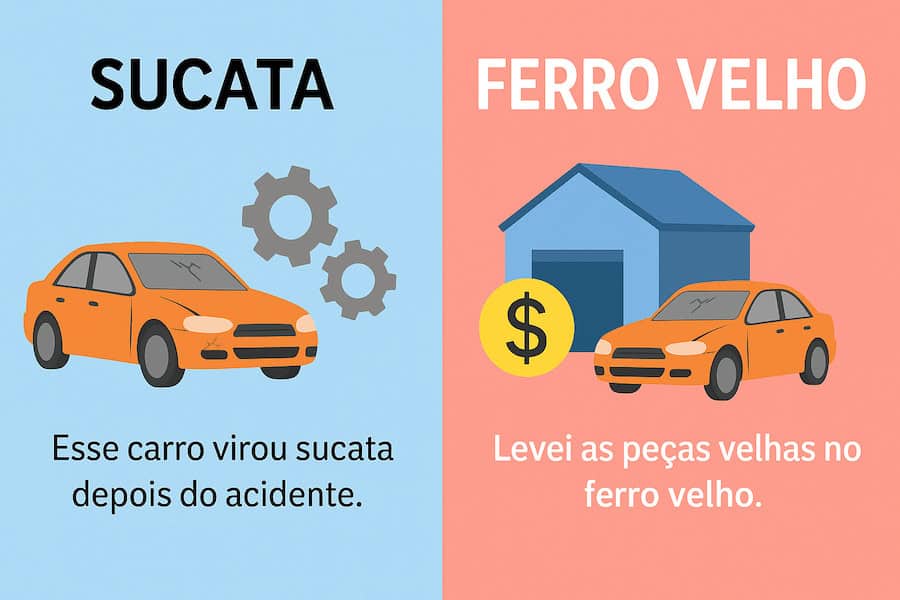
In Brazil, ferro velho and desmanche de carros are not the same thing: a ferro velho buys and sells all kinds of scrap, while a desmanche only takes cars apart and sells their used parts. It's the difference between a scrapyard and an auto salvage yard.
Ferro velho literally means "old iron".
It's the yard or business where scrap metal and used parts of all kinds are sold (not just car parts).

Different ways to say something is damaged, broken or not working
It's what we'd call a "junkyard" or a "scrapyard" in English.
- "Vendi meu carro velho no ferro velho." (I sold my old car to the junkyard.)
Desmanche de carros refers specifically to dismantling cars for parts.
It's the place where old or wrecked cars are taken apart to sell their used parts or recycle the metal.
It's worth pointing out that there are both legal and illegal "desmanches". The illegal ones are what you'd call a chop shop in the US.

Article in Portuguese: Desmanches: como adquirir peças de outros carros sem comprar algo roubado
In American English, the closest equivalents are "salvage yard", "auto wrecker" or "pick-and-pull".
Example: "O carro batido foi levado para o desmanche."
("The wrecked car was taken to the salvage yard.")
Different ways to use VIRAR in Portuguese
In short:
Ferro velho: scrap in general (a junkyard).
Desmanche de carros: an auto salvage yard where cars are dismantled for parts.
Other uses of desmanchar in Portuguese
Besides undoing and taking things apart, desmanchar shows up in several everyday phrases that have nothing to do with cars: your hairdo, a relationship or ice cream that melts. These are the uses you'll hear the most in Brazil.
Desmanchar o cabelo: messing up your hair
Desmanchar o cabelo or desmanchar o penteado means to mess up your hair or ruin your hairdo, something that happens with the wind, a tight hug or when you take off your cap.
- "O vento desmanchou meu penteado antes da festa." (The wind messed up my hairdo before the party.)
Desmanchar o namoro or o noivado: breaking up
Desmanchar o namoro means to break up with your boyfriend or girlfriend, and desmanchar o noivado means to call off the engagement. It's a very common way to say break up in Portuguese without sounding too dramatic. If you're curious about the topic, I'll walk you through dating in Brazil, stage by stage.
- "Eles desmancharam o namoro depois de três anos." (They broke up after three years.)
Desmanchar-se: to melt or fall apart
With the pronoun, desmanchar-se means to melt or fall apart on its own, like ice, ice cream or a piece of candy in your mouth. Figuratively, "desmanchar-se em lágrimas" means to dissolve into tears, in other words, to cry your eyes out.
- "O sorvete se desmanchou no sol." (The ice cream melted in the sun.)
- "Ela se desmanchou em lágrimas no casamento." (She dissolved into tears at the wedding.)
Conjugation of the verb desmanchar
Desmanchar is a regular first-conjugation (-ar) verb, so it follows the same pattern as "falar" and has no surprises. It's always spelled with CH, never "desmanxar" or "desmachar". If you also speak Spanish, take a look at the Portuguese conjugations that sound like serious mistakes in Spanish.
| Pronoun | Present | Past (pretérito perfeito) | Imperfect (pretérito imperfeito) |
|---|---|---|---|
| eu | desmancho | desmanchei | desmanchava |
| você / ele / ela | desmancha | desmanchou | desmanchava |
| nós | desmanchamos | desmanchamos | desmanchávamos |
| vocês / eles / elas | desmancham | desmancharam | desmanchavam |
Gerund: desmanchando (undoing). Past participle: desmanchado (undone). To talk about the future, in Brazil we almost always say "vou desmanchar" (I'm going to undo), using ir + infinitive, just like "going to" in English. I explain this trick in how to use the future tense in Portuguese.


