
What does arregaçar mean? If you're looking up the arregaçar meaning, here's the short answer: arregaçar in Portuguese means to roll up your sleeves, your pant legs or any piece of clothing by folding the fabric up. But in Brazil we use this verb in a lot more ways than the literal one, and its meaning changes quite a bit depending on the context.
The most famous expression is "arregaçar as mangas", the Portuguese way to say roll up your sleeves and get down to work. In everyday speech, when we say someone "arregaçou", it can mean they nailed it, that they crushed someone or, heads up, that we're using the vulgar slang meaning. That's why the meaning of arregaçou depends so much on the tone and on who's saying it.
Below I'll walk you through the 5 ways we use the verb arregaçar, with common phrases and their English translation, plus a short video where I use it just like we do in Brazil. I'll also clear up a common doubt: it's spelled arregaçar, with ç, not "arregassar".
Do you like words that change meaning depending on who says them? Then don't miss this Brazilian slang you'll hear in any conversation.
Video: The different ways to use "Arregaçar" in Portuguese
In this short video I show you how we use the verb arregaçar in Brazil, from rolling up your shirt sleeves to saying someone "arregaçou" in a soccer game. Also pay attention to the sound of ç, which sounds like an S, and if it trips you up, check out my guide to Z, S, SS and Ç in Portuguese.

Literal meaning
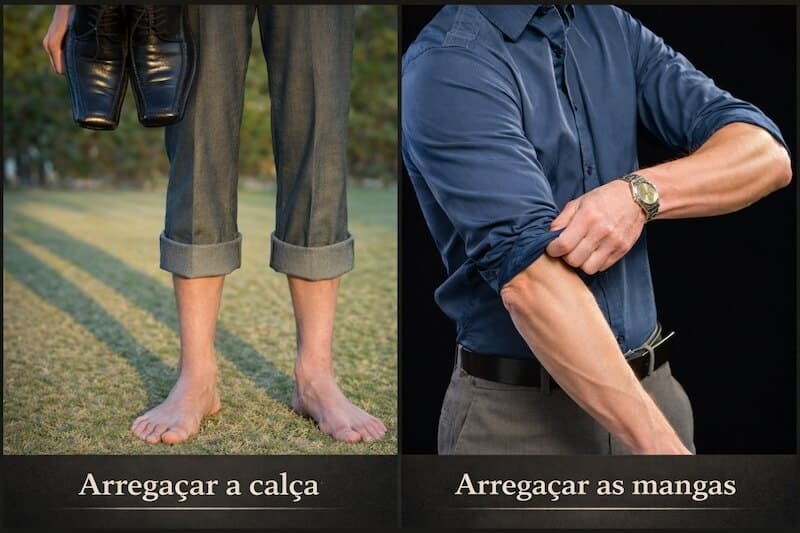
In its literal sense, arregaçar is what you do when you roll up your sleeves or your pant legs. Fun fact: the word comes from "regaço", an old Portuguese word for lap, because it originally meant pulling a skirt up toward the lap. Spanish has a close cousin, "arregazar", with that same old meaning.
Arregaçar means to fold or lift something up, usually clothing.
- Arregaçar as mangas da camisa. (Roll up your shirt sleeves.)
- Arregaçar a calça para não molhar. (Roll up your pants so they don't get wet.)
Core idea: the physical action of folding or lifting.
Figurative meaning: attitude and action
Arregaçar as mangas means to roll up your sleeves and get down to work: stop waiting around and start working on something with energy. It works just like the English "roll up your sleeves", and another expression we use with the same meaning is "pôr a mão na massa" (literally, to put your hand in the dough). If you like these, check out these 22 expressions with mão in Portuguese.
The expression "arregaçar as mangas" is used to say get to work, take action or face a problem with determination.
- Agora é hora de arregaçar as mangas. (Now it's time to roll up our sleeves.)
- Vamos arregaçar as mangas e resolver isso. (Let's roll up our sleeves and sort this out.)
Core idea: initiative, effort, attitude.
"Muitas vezes temos que dar tempo ao tempo. Outras vezes, temos que arregaçar as mangas, e resolver - nós mesmos - determinada situação. Neste caso, não existe pior coisa do que adiar."
Paulo Coelho
26 Portuguese expressions to use at work
Slang meaning: nailing it
When we say in Brazil that someone "arregaçou", it's almost always a compliment: it means that person did an amazing job, just like when you say someone "nailed it" or "killed it" in English. It's one of those Brazilian words you won't find in textbooks.
In everyday speech, arregaçar works as an intensifier and means putting in a lot of effort or standing out.
- Ele arregaçou no treino. (He crushed it at practice.)
- Ela arregaçou na prova. (She aced the test.)
Core idea: top performance, giving it your all.
Strong slang: crushing or wrecking
In its strongest version, arregaçar means to beat someone without mercy or to leave something wrecked: a team that wins 5-0 "arregaçou" the other team, and a storm that rips trees out "arregaçou" the city. Something similar happens with the verb bater in Portuguese, which we also use to talk about hitting and winning.
In informal contexts, it can mean to clearly defeat someone or to cause a lot of damage.
- O time arregaçou o adversário. (The team crushed their opponent.)
- A tempestade arregaçou tudo. (The storm wrecked everything.)

Core idea: strong impact, dominance, destruction.

Vulgar / sexual meaning (warning)
Careful with this one: in a conversation about sex, arregaçar is vulgar and can sound aggressive, so it's better to understand it than to use it. If you want to know which other words to avoid, here's my list of Brazilian Portuguese swear words and insults.
In a sexual context, "arregaçar" is vulgar Brazilian Portuguese slang.
It refers to having sex in an intense, dominant or aggressive way.

- Ele disse que ia arregaçar ontem.
- O cara arregaça mesmo.
This use is very informal, can sound aggressive and isn't appropriate in neutral or formal settings.
Is it spelled arregaçar or arregassar?
It's spelled arregaçar, with ç. The ç (cê-cedilha) sounds like an S and only comes before A, O and U, which is why even a lot of us Brazilians hesitate and write "arregassar", which is wrong. The dictionary also lists the variant "regaçar", but in everyday life almost all of us say arregaçar.
Arregaçar conjugation: arregaça, arregaçou, arregaçado
Arregaçar is a regular -ar verb, so it's conjugated just like falar, which is why you won't find it on my list of irregular verbs in Portuguese. These are the forms you'll hear the most:
- Eu arregaço as mangas antes de cozinhar. (I roll up my sleeves before cooking.)
- Ela arregaça a calça na praia. (She rolls up her pants at the beach.)
- Ele arregaçou na apresentação. (He nailed the presentation.)
- O carro ficou arregaçado depois da batida. (The car was totaled after the crash.)
- Estou arregaçando as mangas para começar. (I'm rolling up my sleeves to get started.)
Notice one detail: before E, the ç turns into C, so you write "que ele arregace" (that he rolls up), never "arregaçe".


