
Looking for the acenar meaning? In Portuguese, acenar means making a gesture with your hand, your head or even your eyes to say hi, say goodbye, call someone over or say yes. So what is acenar in English? Depending on the context, it translates as "to wave", "to nod", "to signal" or "to gesture".
The two uses you'll hear the most are "acenar com a mão" (to wave) and "acenar com a cabeça" (to nod). If you've ever wondered how to say wave in Portuguese, this is your word: "ela acenou pra mim" simply means "she waved at me". And watch out, it has nothing to do with "assentir" (to assent) or with food. Portuguese is full of words that don't mean what they seem, so it's worth checking out these false cognates in Portuguese too.
The verb acenar is regular and follows the same acenar conjugation pattern as any other verb ending in -ar, so you'll hear forms like "acenou" (waved), "acenei" (I waved) and "acenando" (waving) all the time. And it's always spelled with a C: never "ascenar" or "assenar", two really common mistakes.
Below I'll show you how to use acenar to say hello, to say goodbye and to get someone's attention, with everyday sentences and their English translation. And since acenar almost always comes with other gestures, it's also worth taking a look at the hand gestures we use in Brazil.
Video: Acenar in Portuguese
In this short video I show you the meaning of acenar in practice: it's the gesture we make in Brazil to say hi, say goodbye or call someone over without saying a word. Watch it, then go through each use below with its example sentence and translation.

Acenar para cumprimentar (to wave hello)
Acenar para cumprimentar means greeting someone with your hand, usually from a distance, when you can't really talk. It's the most common use of the verb, and in English we'd simply say "to wave". If you want to add the words that go with the gesture, check out the most common greetings in Portuguese.
- Ela me viu de longe e acenou com a mão. (She saw me from far away and waved at me.)
Greetings and farewells in Portuguese
Acenar para se despedir (to wave goodbye)
Acenar para se despedir means waving goodbye, like when someone drives off or gets on the bus. Notice that the sentence below uses "ir embora", the most common way to say "to leave" in Brazil; I explain all about it in how to say I'm leaving and let's go in Portuguese.
- Ele acenou antes de entrar no carro e ir embora. (He waved before getting in the car and driving off.)
20 ways to call someone when you don't know their name
How to use Porém, Embora and Ir Embora
Acenar to get someone's attention
Acenar is also signaling so someone sees you or comes over, like flagging down the waiter at a restaurant or waving to a friend in a crowd. It's the same as "waving someone over" in English, and it often goes together with a polite "com licença".
- Acenei para o garçom trazer a conta. (I signaled the waiter to bring the check.)
Quick note: "acenar" isn't limited to your hand; you can also acenar with your head, for example to show approval or to acknowledge someone without saying a word.
Hand gestures we use in Brazil
Acenar com a cabeça (to nod)
Acenar com a cabeça means moving your head to say yes, agree with something or acknowledge someone without talking. In English that's "to nod" or "to nod your head". It's really common in meetings, in class or when someone greets you from a distance.
- Ela acenou com a cabeça e concordou com a proposta. (She nodded and agreed to the proposal.)
Acenar in a figurative sense (to signal)
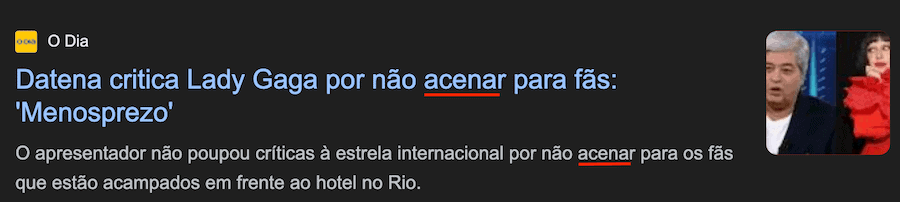
Acenar can also mean signaling or hinting that something might happen, with no physical gesture at all. You'll see this use a lot in the news and in headlines, like the one in the image above. If you read the Brazilian press, you'll also like how to react to news in Portuguese.
- O governo acenou com a possibilidade de baixar os impostos. (The government signaled it might lower taxes.)
Acenar conjugation
The verb acenar is regular, so it's conjugated like any other verb ending in -ar, no surprises. The forms you'll hear the most are "acenou" (waved), "acenei" (I waved) and "acenando" (waving). If you want to compare it with the verbs that do change, take a look at this list of irregular verbs in Portuguese.
- Presente: eu aceno, você/ele acena, nós acenamos, vocês/eles acenam
- Pretérito perfeito: eu acenei, você/ele acenou, nós acenamos, vocês/eles acenaram
- Gerúndio: acenando (Ela estava acenando pra mim. / She was waving at me.)
- Particípio: acenado (Ele tinha acenado antes de sair. / He had waved before leaving.)
Heads up: in Portuguese, "acenamos" works for both the present and the past (we wave / we waved), a lot like "we put" or "we read" in English, so the context tells you which one it is. And if conjugation gives you a headache, check out these Portuguese conjugations that trip learners up.


